Smart Coolers for Manufacturing Plants: The Shift Worker Food Problem, Solved
Smart coolers for manufacturing plants address one of the most persistent operational challenges in industrial environments: feeding a workforce that runs around the clock, often in locations with no nearby food options, with breaks too short to accommodate off-site meals.
Traditional vending machines were the default answer for decades. They're still common in manufacturing break rooms — stocked with chips, candy bars, and shelf-stable sandwiches that no one would eat by choice. Smart coolers change the equation entirely: fresh meals, available 24/7, maintained at safe temperatures, paid for with a tap of a card or phone.
For plant managers, HR teams, and operations leaders at Atlanta-area manufacturing facilities, here's why smart coolers are the right solution and how to implement them effectively.
The Specific Food Challenges Manufacturing Plants Face
Manufacturing environments aren't like office buildings. The food service challenges are more acute and harder to solve with conventional approaches.
Multiple Shifts, All-Day Access Needs
Three-shift operations run 24 hours. Day-shift workers might have access to a vending area during normal hours, but second-shift and third-shift workers — often the majority of the workforce at high-volume facilities — have dramatically worse options. If a facility has a cafeteria, it usually closes by 2 PM. If it doesn't, workers rely entirely on vending machines that haven't been restocked since the morning.
The practical result: third-shift workers finish 10-hour shifts having eaten nothing but chips and a candy bar. That's a nutrition deficit, a safety concern, and a quality-of-life problem that good workers notice and remember when evaluating other opportunities.
Short Breaks and Distance Constraints
Manufacturing break rooms are often centrally located within a large facility — not near the production floor where workers spend their time. In large plants, walking from the floor to the break room and back can consume half of a 30-minute break. When that walk leads to a vending machine with limited options, workers often skip eating or bring food from home rather than engage with what's available.
Smart coolers placed strategically within or adjacent to production areas minimize transit time and make the break actually restful.
Remote Facility Locations
Many manufacturing facilities are in industrial parks, suburban or exurban corridors, or rural areas with no commercial food options within a reasonable drive. The closest restaurant might be 20 minutes away — effectively inaccessible during a standard break.
In these environments, on-site food quality is the only food quality. Workers either eat what's available in the facility or go without. Smart coolers ensure that "what's available" means fresh, nutritious meals rather than processed snacks.
Physical Work Demands
Manufacturing workers perform physically demanding labor. Their nutritional needs — particularly for protein, complex carbohydrates, and adequate calories — are higher than those of office workers. The high-sodium, high-sugar, low-protein profile of typical vending machine offerings is a particularly poor match for the actual needs of this workforce.
Workers who fuel well perform better, have fewer accidents, and recover more effectively. The connection between worker nutrition and workplace safety is well documented in industrial health research.
Why Traditional Vending Fails in Manufacturing
The spiral vending machines found in most manufacturing break rooms have three fundamental problems:
Wrong food type: Shelf-stable snacks aren't meals. Workers who need genuine nutrition during a shift break aren't served by a machine that offers candy bars and crackers.
Unreliable operation: Nothing is more demoralizing than a vending machine that takes your money and doesn't deliver. In manufacturing environments, where margins are already thin and labor relations matter, equipment failures create outsized frustration.
Cash dependency: Many traditional machines still require cash or coins. Workers who don't carry cash skip the machine entirely, which means they skip eating.
Smart coolers solve all three problems: fresh food, reliable technology, and cashless payment.
How Smart Coolers Work in Manufacturing Environments
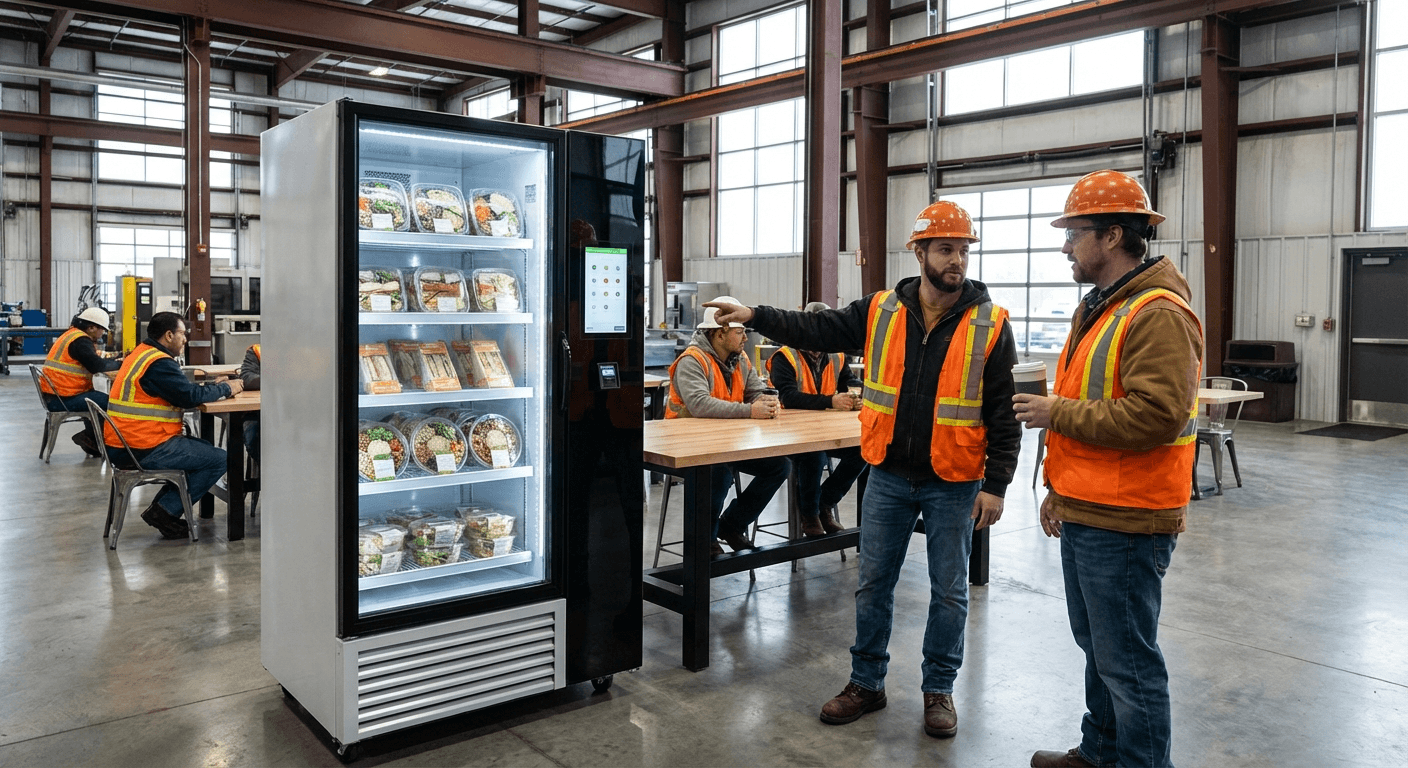
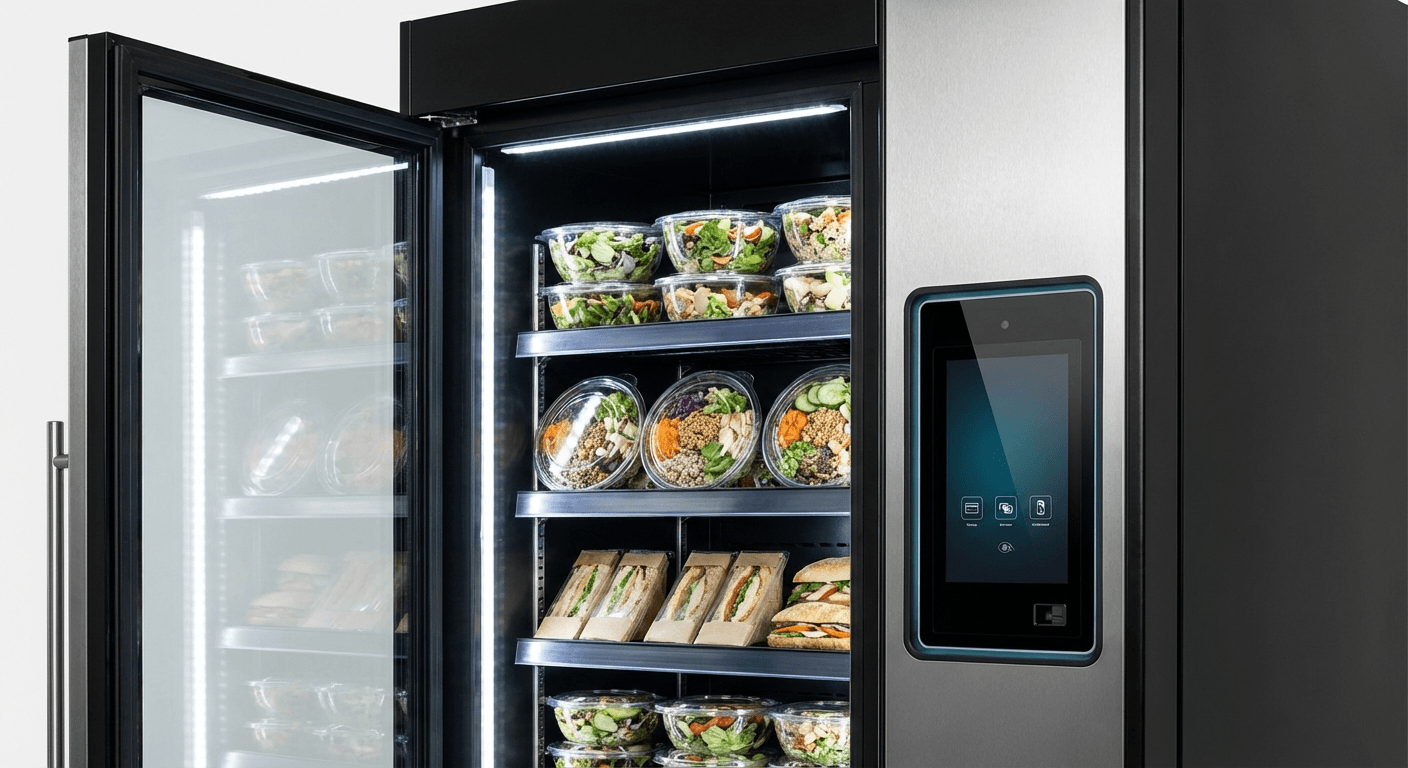
A smart cooler is a refrigerated vending unit that holds fresh-prepared meals — salads, sandwiches, wraps, hot entrées in microwave-safe containers, soups, yogurt, fruit — maintained at safe refrigeration temperatures around the clock.
Payment is cashless: tap-to-pay with a credit or debit card, Apple Pay or Google Pay, or badge integration if desired. Inventory is tracked in real-time, so the vendor knows when items are running low and restocks proactively rather than waiting for complaints.
In a managed service arrangement, the facility pays nothing for equipment, installation, or ongoing management. The vendor handles everything.
Durability for Industrial Environments
Manufacturing environments are harder on equipment than offices. Smart cooler units designed for commercial/industrial use are built with this in mind: stainless steel exteriors, heavy-duty refrigeration components, and reinforced glass. Ask any vendor you're evaluating to specify whether their equipment is rated for industrial environments.
Placement Strategy for Manufacturing
The best smart cooler placement in manufacturing facilities:
Near break room entrances: Immediate access as workers arrive for their break. No additional transit time within the break room.
Multiple units for large facilities: A single unit serving 200+ workers on a shift change creates bottlenecks. Two or three units distributed across different break areas serve the workforce more effectively and generate higher total utilization.
Near the production floor when possible: If layout allows, placing units within accessible distance of the floor reduces the transit time burden and encourages use during short breaks.
24-hour visibility: Ensure the location is accessible and visible for all three shifts. A cooler in a room that's locked or poorly lit after 8 PM doesn't serve night-shift workers.
Menu Design for Manufacturing Workers
Manufacturing workers have different needs than office employees, and smart cooler menus should reflect that.
High protein: Grilled chicken bowls, protein wraps, hard-boiled eggs, Greek yogurt. Physical labor demands more protein than desk work.
Substantial portions: Workers doing manual labor need actual calories. Small portions designed for office workers won't satisfy.
Hearty options for late shifts: Third-shift workers often want warming, comfort-forward options — soups, hot entrées, substantial sandwiches.
Variety: Workers eating from the same cooler 5 days a week will disengage if the menu doesn't rotate. Good vendors rotate weekly or bi-weekly based on consumption data.
Dietary diversity: Modern manufacturing workforces are diverse. Vegetarian and vegan options, halal-friendly items, and gluten-free choices should be consistently available.
The Retention Case for Manufacturing
Employee turnover in manufacturing is a significant operational cost. Replacing a production worker — accounting for recruitment, onboarding, training, and the productivity ramp-up period — costs thousands of dollars per hire. At facilities with high turnover rates, the annual cost can be substantial.
Workplace amenities, including quality food access, are among the factors manufacturing workers cite when evaluating whether to stay at a facility. They're not the primary driver of turnover, but they contribute to the cumulative experience that determines whether workers feel valued.
Investing in fresh food access signals that the organization sees its workers as people worth investing in — not just production units. That signal matters in retention conversations and in the cultural reputation that drives recruiting in tight labor markets.
For a broader view of how fresh food programs affect employee retention, see fresh food vending and employee retention.
Implementation for Atlanta Manufacturing Facilities
The implementation process for a manufacturing plant is similar to other facility types, with a few specific considerations:
Shift schedule integration: The vendor needs to understand your shift structure to build restocking schedules that ensure freshness across all shifts. A single Monday morning restock doesn't work for a 24/7 three-shift operation.
Security and access protocols: Many manufacturing facilities have restricted areas and badged entry systems. Work with your vendor to ensure restocking staff have appropriate access without creating security gaps.
Employee communication: A brief announcement to all shifts explaining the new program, payment options, and how to provide feedback helps build initial adoption. Workers who know about the cooler use it; workers who don't discover it by accident.
Feedback mechanism: A simple way for workers to suggest menu items or flag quality issues keeps the program improving over time.
Get Smart Coolers for Your Atlanta Manufacturing Facility
Replenished Markets serves manufacturing and industrial facilities across metro Atlanta with fresh food smart cooler programs. Zero cost to install, zero management burden, and menus designed for the actual needs of industrial workers.
Contact us to schedule a site assessment. We'll review your facility layout, shift schedule, and workforce size and recommend a program that serves your team effectively. You can also explore our dedicated page on fresh food vending for manufacturing facilities for more details.