ROI of Smart Coolers in 2026: What the Numbers Actually Show
ROI on smart coolers is a more complex calculation than most facility managers expect going in — and in most cases, a more favorable one.
The surface-level question is: does the revenue from product sales exceed the cost of the equipment and service? But that framing misses most of the value. The full ROI calculation for smart coolers includes direct financial returns, employee retention value, productivity effects, and energy efficiency compared to alternatives.
This guide walks through each component with realistic estimates, so you can build an honest business case — not just a sales pitch.
Component 1: Direct Financial Return
Revenue Sharing
In managed service agreements (the most common model for businesses), the facility pays $0 for equipment and service. Some agreements also include revenue sharing: the facility earns 5–15% of gross product sales.
Example calculation:
- 200-employee facility
- Estimated $8–$12 average purchase per person per week (some skip, some buy daily)
- Conservative estimate: 100 purchases/week at $8 average = $800/week = $3,200/month gross sales
- 10% revenue share = $320/month to the facility, or approximately $3,800/year
This isn't life-changing revenue, but it's real money from an amenity that otherwise costs nothing. At larger accounts, the numbers scale meaningfully.
Cost Avoidance vs. Traditional Vending
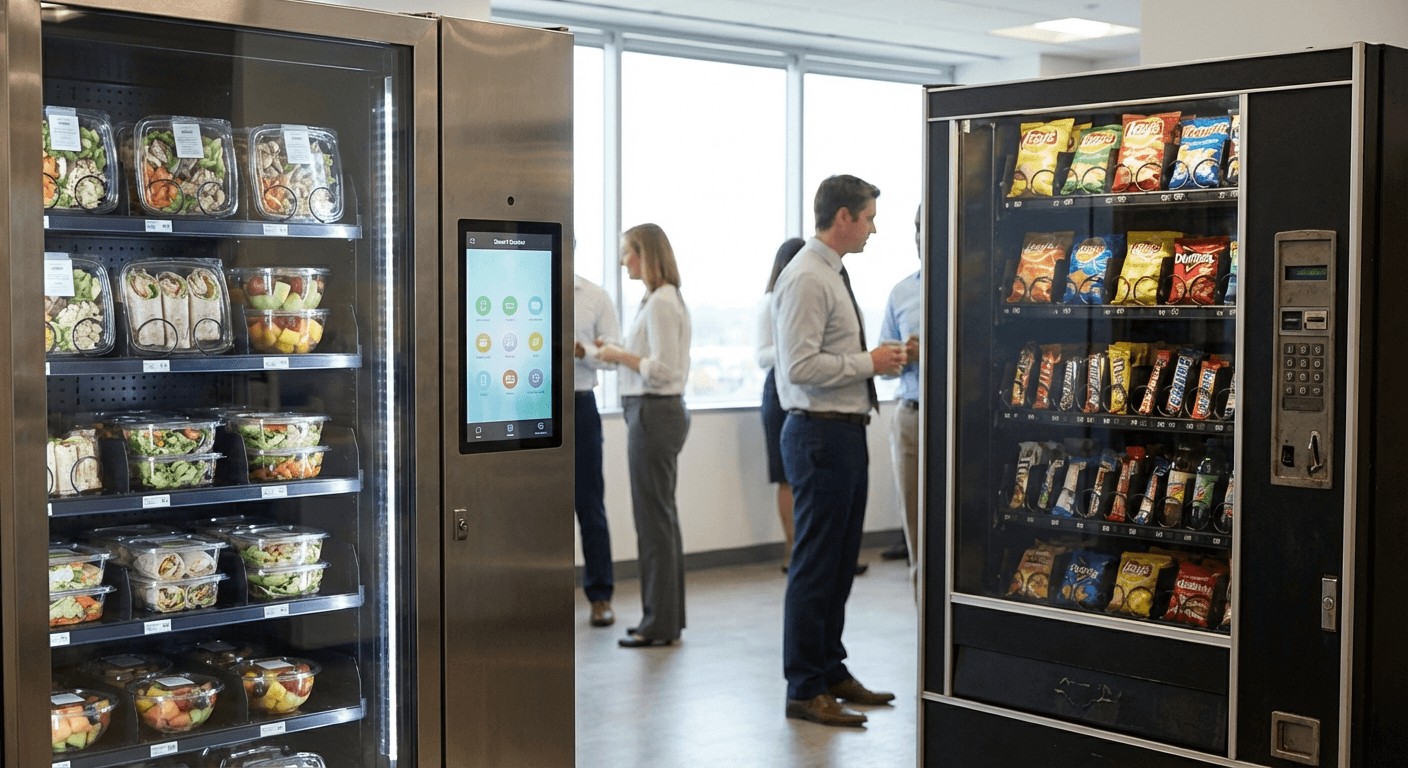
If you're replacing traditional vending machines with smart coolers, consider what you're avoiding:
Traditional vending machine costs:
- Equipment purchase or lease: $2,000–$5,000/unit
- Ongoing maintenance: $500–$1,500/year
- Cash handling and reconciliation time
- Frequent repairs and lost revenue from malfunctions
In a managed service model, all of these costs transfer to the vendor. The facility's direct cost drops to near zero.
Component 2: Employee Retention Value
This is typically the largest component of smart cooler ROI — and the hardest to quantify precisely. Here's how to think about it.
The Cost of Employee Turnover
Replacing an employee costs the equivalent of 6–9 months of their salary when you account for:
- Job posting and recruitment costs
- Recruiter fees (if applicable — typically 15–25% of first-year salary)
- Interview and selection time
- Background checks and onboarding paperwork
- Training time and trainer labor cost
- Productivity ramp-up period (3–6 months for most roles)
- Overtime coverage during the gap
For a $50,000/year employee, turnover cost is roughly $25,000–$45,000. For healthcare roles like registered nurses, it's higher — often $40,000–$80,000 per replacement.
The Smart Cooler's Contribution to Retention
Workplace amenities are documented contributors to employee retention decisions. Food access specifically appears consistently in employee satisfaction surveys as a factor in workplace quality ratings.
Smart coolers are not the reason people stay at a job. They contribute to the cumulative experience of being treated well by an employer — an experience that accumulates over months and influences turnover decisions at the margin.
Conservative scenario: A 200-person facility retains 1 employee per year who would otherwise have left, in part due to workplace quality improvements including food access.
Value of that retention: $25,000–$45,000 in avoidable turnover costs.
Against a smart cooler program that costs $0 upfront, even this conservative single-retention scenario produces a significant positive return.
For a deeper look at the retention dynamic, see fresh food vending and employee retention.
Component 3: Productivity Value
Reduced Long Lunch Departures
Employees at facilities without on-site food options frequently leave for 45–60 minutes during lunch — 30–45 minutes in transit and wait time, plus the actual meal.
With a smart cooler, the same employee grabs a meal in under 5 minutes and returns to their workspace. Time recovered: 25–40 minutes per person per day.
Example calculation:
- 50 employees who previously left campus for lunch
- Average 30 minutes recovered per day
- 250 working days per year
- 50 employees × 0.5 hours × 250 days = 6,250 hours/year
- At average fully-loaded labor cost of $30/hour: $187,500 in recovered productivity time
This is a theoretical maximum (not everyone will use the cooler, not every minute is productive), but even at 10% efficiency, it represents meaningful value.
Shift Worker Productivity
For manufacturing plants, hospitals, and other facilities where workers do physical or cognitively demanding work, nutrition quality directly affects performance. Workers who eat real food perform better, have fewer accidents, and sustain output more consistently through a shift.
This effect is difficult to attribute precisely to a food program, but it's the underlying reason healthcare and industrial organizations invest in worker nutrition.
Component 4: Energy Efficiency Comparison
If you're replacing older equipment (traditional vending machines or an outdated cafeteria line) with smart coolers, energy efficiency may be a cost savings component.
Modern smart coolers use energy-efficient compressors, LED lighting, and smart scheduling that reduces power draw during low-activity periods.
Typical monthly electricity consumption:
- Modern smart cooler: 150–300 kWh/month
- Traditional vending machine (older model): 200–400 kWh/month
- Full cafeteria line (if replacing partial service): significantly higher
At Atlanta commercial electricity rates, a smart cooler typically costs $20–$50/month to operate. This compares favorably to the energy cost of maintaining even a partial food service operation.
Component 5: Health and Safety Benefits
Reduced Off-Site Incidents
Workers who leave a facility campus during breaks are exposed to traffic accidents, weather, and other off-site risks. Workers' compensation claims related to off-site incidents during work hours are a documented cost category for some employers.
Smart coolers reduce the incentive to leave campus for food, which reduces this exposure. This is a small but real component of the total risk picture.
Healthcare Worker Performance
For healthcare organizations specifically, there's a patient safety dimension to nutrition. Fatigued, under-nourished nurses and physicians make more errors. Investment in staff nutrition has downstream effects on clinical quality — a cost that's extremely difficult to quantify but important to recognize.
Putting It Together: A Sample ROI Model
For a 200-person corporate office facility adopting smart coolers under a managed service agreement:
| ROI Component | Conservative Estimate | Notes |
|---|---|---|
| Equipment/installation cost | $0 | Managed service model |
| Monthly operational cost | $30–$50/month electricity | Only direct cost |
| Revenue sharing (annual) | $2,000–$5,000 | At 10%, high-volume accounts |
| Turnover avoidance (annual) | $25,000–$90,000 | 1–2 retained employees |
| Productivity recovery (annual) | $10,000–$50,000 | Conservative efficiency estimate |
| Net annual benefit | $35,000–$145,000 | Excluding electricity cost |
The range is wide because the retention and productivity components are estimates. But even the low end of this range represents a strong return on a zero-cost investment.
ROI for Healthcare Facilities
The ROI calculation shifts for hospitals and healthcare facilities, where:
- Turnover costs are higher per employee (nursing replacement is $40,000–$80,000+)
- Patient safety effects have financial implications (HCAHPS scores, adverse event costs)
- Night-shift staff represent a disproportionate share of turnover risk
Healthcare facilities typically see faster and larger retention ROI from smart cooler programs than general corporate accounts, making the investment case even more compelling.
Questions to Ask When Building Your ROI Case
What is your current annual turnover rate? Even a 1–2% improvement in retention at a facility with high-cost roles generates significant return.
How many employees currently leave campus for lunch? This quantifies the productivity opportunity.
What does your current vending program cost? If you're paying for maintenance contracts or splitting revenue with a traditional vending vendor, the managed service model eliminates those costs.
What is your electricity rate? This determines your only direct operational cost in a managed service arrangement.
Does your organization report on employee satisfaction metrics? If yes, smart cooler adoption can be tracked against those metrics as a documented investment.
See the Numbers for Your Facility
Every facility's ROI calculation is different. Replenished Markets will walk through a customized analysis for your facility during a consultation — at no cost and with no obligation.
Contact us to schedule your consultation. You can also review how much does a smart cooler cost for more detail on the cost side of the equation.