Smart Coolers for Commercial Office Buildings: What Property Managers Need to Know
Smart coolers for commercial office buildings have emerged as one of the most practical, cost-effective tenant amenities available to property managers competing in Atlanta's post-pandemic leasing market.
The dynamic is straightforward: hybrid work reduced average office density, tenants gained leverage in renewal negotiations, and building amenities went from nice-to-have to decision-driving criteria. Property managers who invested in tenant experience have maintained occupancy. Those who didn't are dealing with the consequences.
Smart coolers occupy a sweet spot in the amenity landscape: high visibility to tenants, immediate daily impact, zero capital cost to the property, and no ongoing management burden. No construction. No food service contract. No operational complexity.
Here's what every property manager in the Atlanta market should understand about smart cooler programs.
Why Food Access Is a Top Tenant Priority
Tenants evaluate office buildings on a range of factors: location, transit access, parking, common area quality, and increasingly, amenities that affect the daily employee experience.
Food access ranks consistently among the top concerns for office tenants whose buildings lack on-site cafeterias or walkable dining. This is especially true in Atlanta's suburban office markets — Cumberland, Perimeter, Gwinnett, Buckhead, Marietta — where many tenants occupy office parks with limited nearby restaurant options.
When employees can't access a real meal without a 15-minute drive, the building itself becomes a source of friction. That friction comes up in tenant satisfaction surveys, in renewal conversations, and — increasingly — in decisions about where employees want to work in a hybrid arrangement.
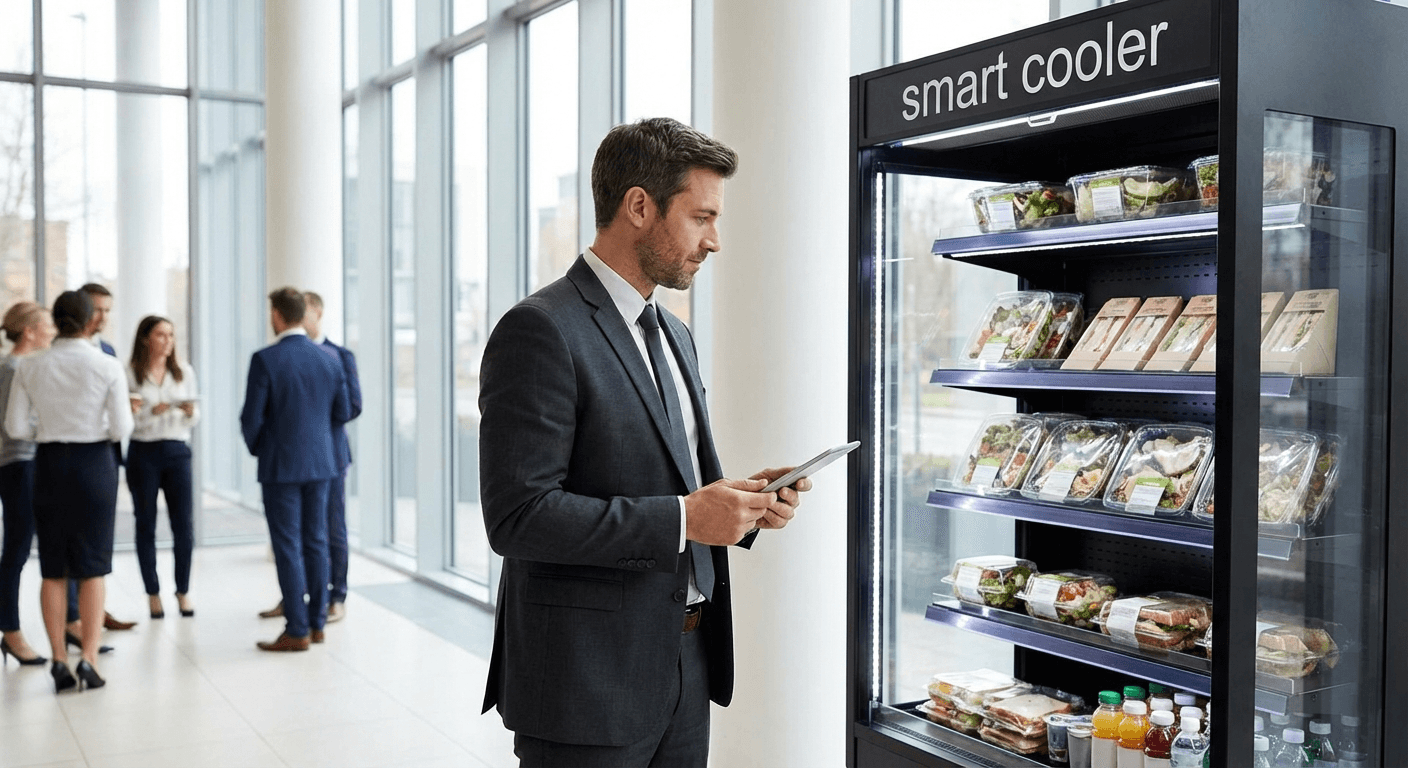
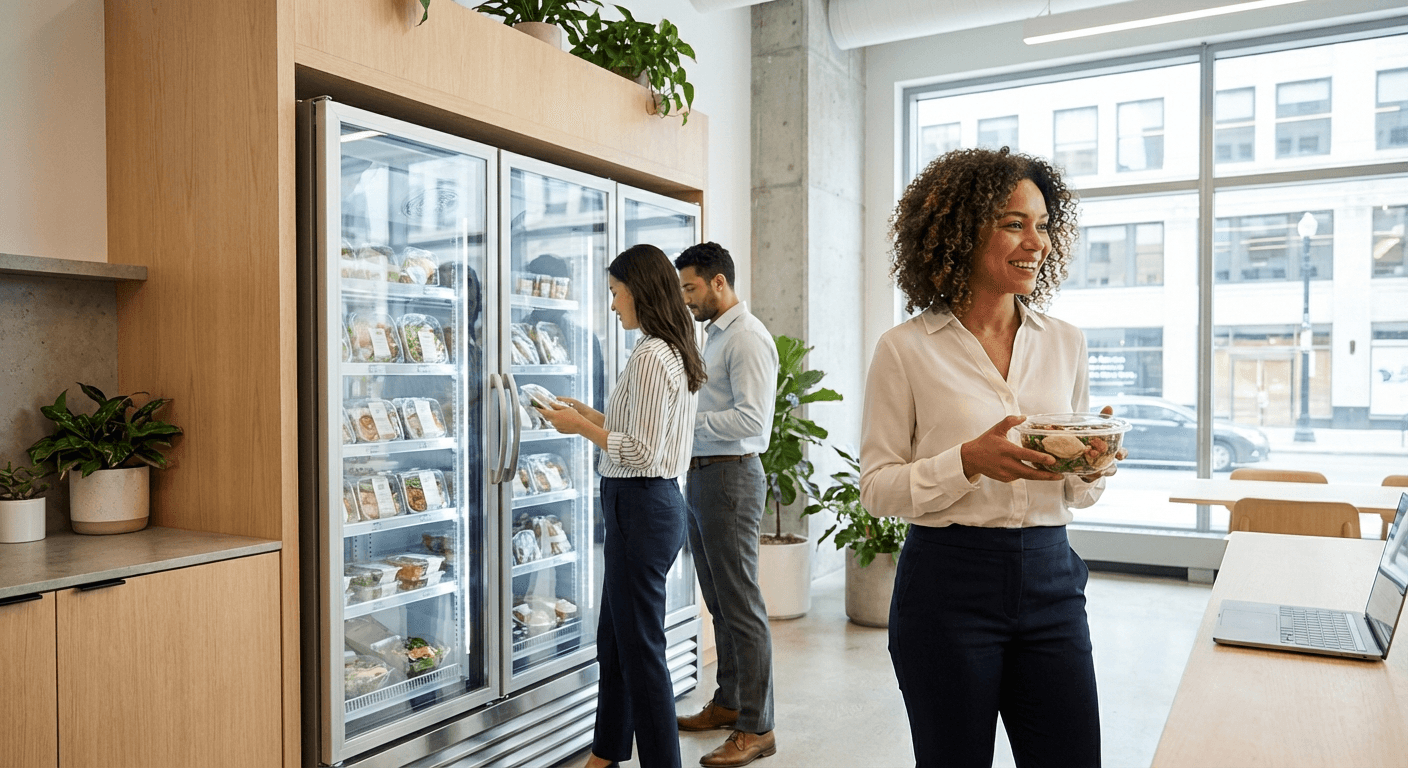
A well-stocked smart cooler in the lobby or building common area changes that calculus. Employees can grab a quality lunch in under 5 minutes without leaving. The building becomes an easier place to work, not a harder one.
The Property Manager Value Proposition
Zero Capital Investment
Smart cooler programs for commercial buildings typically operate under managed service agreements: the vendor provides equipment, handles installation, manages stocking and maintenance, and carries all food safety responsibility. The building provides floor space and an electrical outlet.
No renovation budget required. No food service contract to negotiate. No RFP process for a cafeteria operator. The simplicity is a feature.
No Ongoing Management Responsibility
Property management teams are not equipped to run food service programs, and they shouldn't have to be. A managed service smart cooler vendor handles:
- Regular restocking based on real-time inventory data
- All equipment maintenance and repairs
- Temperature monitoring and food safety compliance
- Payment processing
- Monthly reporting
Your involvement is limited to approving placement and occasionally communicating feedback to the vendor. That's it.
Tenant Satisfaction Improvement
Tenant satisfaction scores influence lease renewals. Every incremental improvement in how tenants rate the building experience has a downstream effect on occupancy rates and achieved rents.
Smart coolers generate positive feedback specifically in two areas tenants consistently rate: food access and building amenity quality. For buildings in markets where tenants have alternatives, these improvements matter.
Competitive Differentiation
In a market where many competing buildings are similar on the core fundamentals — location, square footage, price — amenity differentiation becomes a genuine decision factor. "Our building has fresh food available throughout the day" is a concrete, tangible point of difference that a tenant's employees will experience daily.
Property managers who can articulate this in leasing presentations and renewal conversations have a talking point that competing buildings without food amenities cannot match.
Implementation for Commercial Office Buildings
Optimal Placement
For multi-tenant commercial buildings, smart cooler placement decisions require balancing accessibility for all tenants with practical logistics:
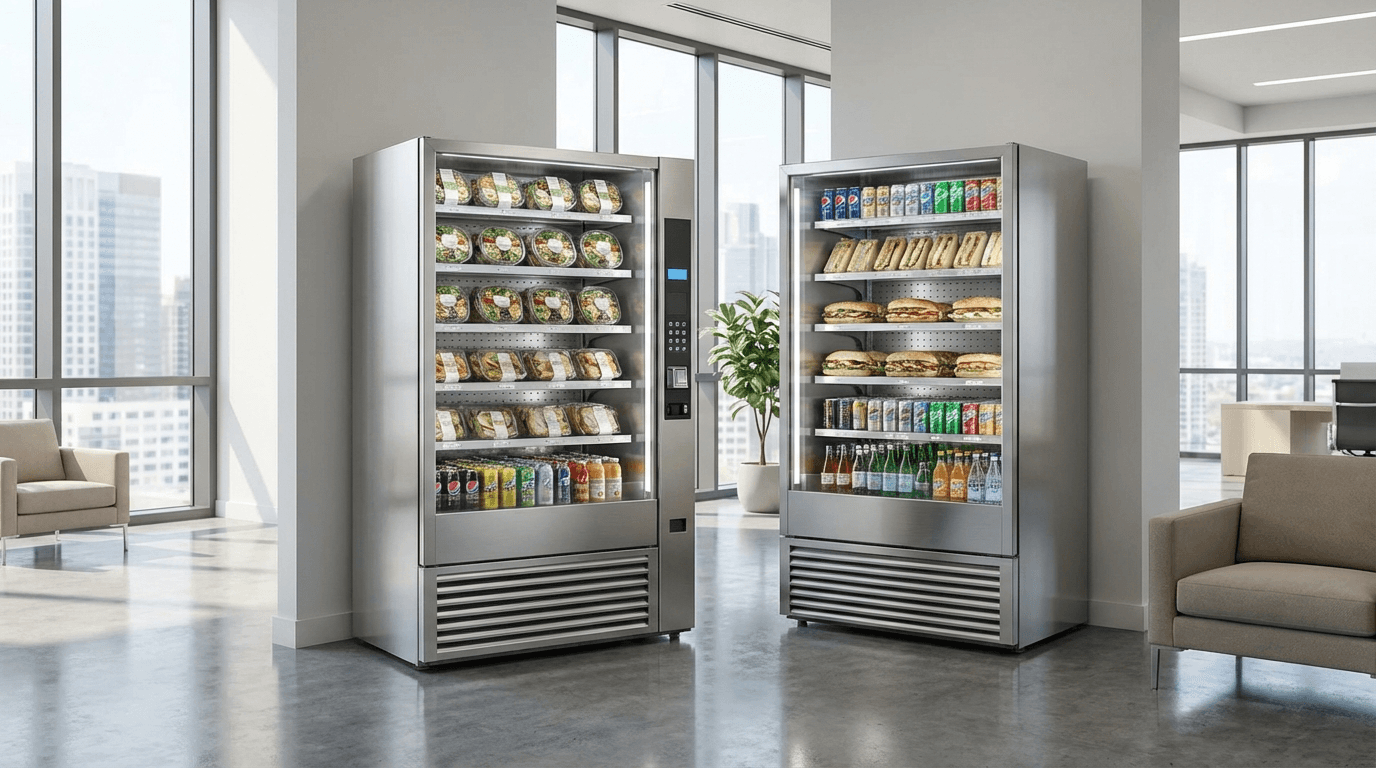
Ground floor lobby or common area: Highest visibility, accessible to all tenants, serves visitors and meeting attendees in addition to regular building occupants. Best for buildings with a significant lobby amenity area.
Building café or food service area: If the building has an existing café or food service space that doesn't operate evenings and weekends, a smart cooler extends coverage to those hours at no additional cost.
Parking garage or building entrance: Some buildings place units near parking exits for convenient grab-and-go as employees arrive or depart.
Individual tenant floors: Larger tenants (10,000+ sq ft) sometimes request units on their floor rather than in common areas. This is a tenant-specific conversation, but it creates a differentiated offering for anchor tenants.
Building Class Considerations
Class A buildings: Full-featured smart coolers with premium menus and design-forward aesthetics. These buildings have tenant expectations for quality amenities. Lower-quality equipment or menus will create rather than solve problems.
Class B buildings: Smart coolers as a primary food amenity addition where little or nothing currently exists. Even a standard program significantly improves tenant satisfaction compared to the status quo.
Class C and Value-Add: Smart coolers as part of a broader amenity improvement program. Fresh food access is one of the highest-ROI investments in a building repositioning.
Multi-Tenant Communication
In multi-tenant buildings, coordinate with building management to communicate the new amenity to all tenants. A brief email to tenant contacts announcing the program, explaining payment options, and inviting feedback accomplishes this effectively.
Tenants who know the smart cooler is there and understand how to use it will adopt it. Tenants who discover it by accident weeks later are an underutilization problem.
Revenue Considerations for Property Managers
Revenue Sharing
For buildings with sufficient traffic volume, smart cooler vendors often include a revenue sharing component in their agreement — a percentage of gross product sales paid to the property.
Revenue sharing is more common and more meaningful at high-traffic, high-volume accounts. For a typical multi-tenant office building, the amounts are modest but real.
Tenant Amenity Fee Structures
Some property managers include food access amenities as part of their tenant amenity package, potentially justifying a modest premium on amenity-inclusive rent structures. This is a lease structuring question more than a vendor question, but it's worth considering when positioning the program to ownership.
Reduced Tenant Churn Costs
Tenant turnover is expensive: vacancy periods, broker commissions, tenant improvement allowances, legal costs. Any amenity investment that contributes to renewal decisions reduces these costs. The retention ROI of smart coolers in commercial buildings mirrors the retention ROI in individual corporate accounts.
What to Look for in a Vendor
Commercial office building accounts have different requirements than individual corporate tenants:
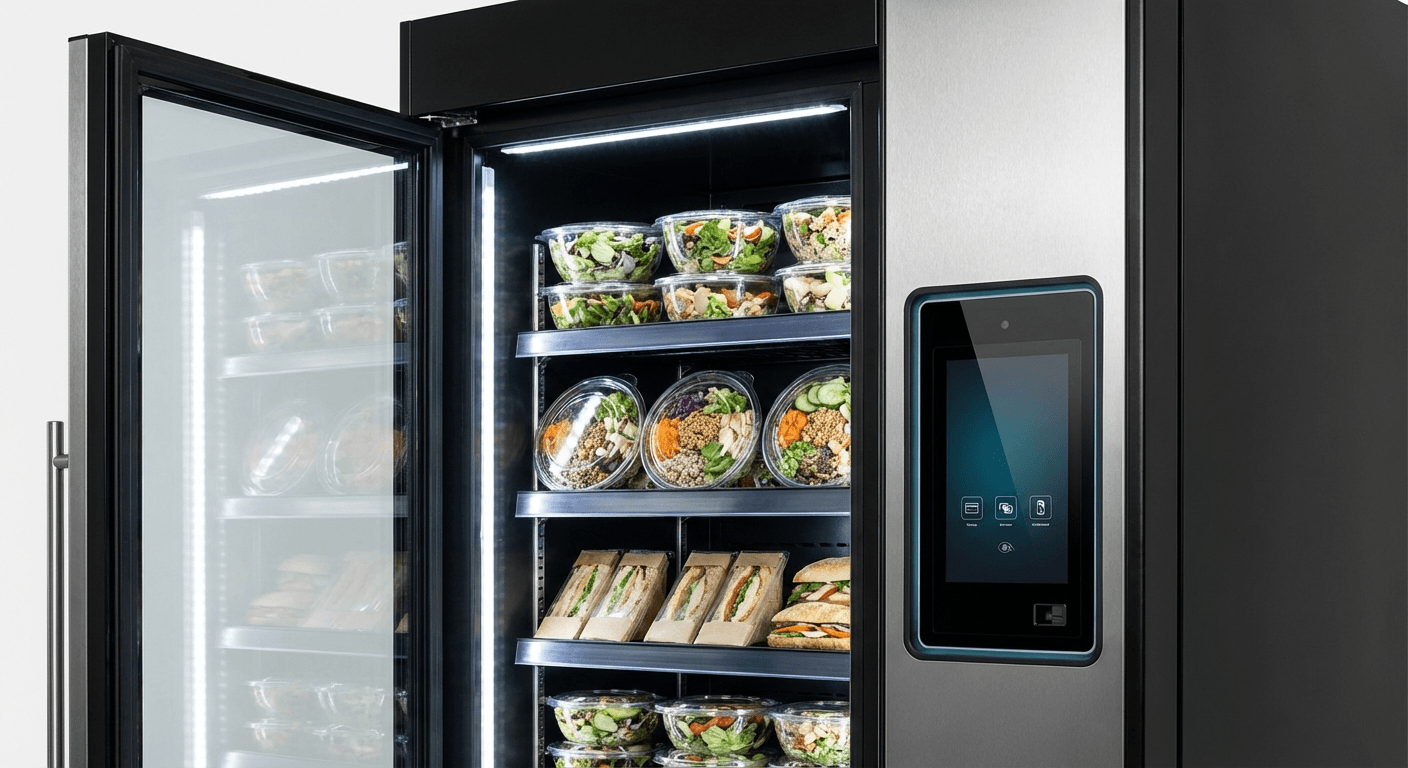
Aesthetics matter: Building management should review the physical design of the unit before installation. A poorly designed unit in a Class A lobby creates the wrong impression. Quality vendors offer premium equipment appropriate for high-end environments.
Menu quality represents the building: The food in a shared building smart cooler reflects on the building's overall quality positioning. Mediocre food is worse than no food in a building where tenants have high expectations.
Reliability is non-negotiable: An empty or broken smart cooler in a building common area reflects on property management. Ask vendors about their average uptime and response time for maintenance issues.
References from comparable buildings: Request references from similar commercial properties — same market, similar class. A vendor experienced with individual corporate accounts may not be the right fit for a shared multi-tenant environment.
Smart Coolers and the Future of Office Amenities
The office buildings with the highest tenant satisfaction in 2026 share a common characteristic: they've invested in daily employee experience, not just physical infrastructure. Smart coolers are part of a broader amenity ecosystem that includes fitness centers, conference facilities, outdoor spaces, and concierge services.
Fresh food access is perhaps the most impactful because it affects everyone, every day. You don't have to use the gym every day. You do have to eat.
For property managers evaluating amenity investments that deliver tenant satisfaction improvements with minimal operational complexity and zero capital cost, smart coolers are the clearest starting point.
Get Started with Your Commercial Building Smart Cooler Program
Replenished Markets serves commercial office buildings across metro Atlanta, including multi-tenant properties managed by regional and national property management firms. We understand the multi-tenant context, provide equipment and service appropriate for Class A environments, and manage everything so your team doesn't have to.
Contact us to discuss your building's specific configuration and schedule a site assessment. You can also explore fresh food vending for property managers for more detail on how we serve the commercial real estate sector.